About MCA
The Master of Computer Applications (MCA) program provides a comprehensive understanding
of developing efficient software and computer applications. Combining theoretical concepts
with practical training, the program equips students with the necessary tools to design and build
sophisticated applications while staying updated with industry trends. It also prepares them to
excel in a competitive professional environment.
To enhance learning, the institute employs diverse teaching methodologies, including lectures, presentations, seminars, workshops, laboratory sessions, and project work. These approaches help students develop conceptual, analytical, and decision-making skills, ensuring they are ready to tackle real-world challenges in organizational settings. Student performance is continuously evaluated through assignments, presentations, software experimentation, quizzes, tests, and mid-term and semester-end examinations, maintaining high academic standards in both theoretical and practical aspects.
While classroom instruction and laboratory work form the foundation of the program, the institute strongly encourages students to engage in hands-on project implementation. This process involves gathering project requirements, system analysis, and designing a computerized system for execution. Ultimately, students compile a detailed project report and present their work before experts for evaluation, reinforcing their technical and problem-solving abilities.
To enhance learning, the institute employs diverse teaching methodologies, including lectures, presentations, seminars, workshops, laboratory sessions, and project work. These approaches help students develop conceptual, analytical, and decision-making skills, ensuring they are ready to tackle real-world challenges in organizational settings. Student performance is continuously evaluated through assignments, presentations, software experimentation, quizzes, tests, and mid-term and semester-end examinations, maintaining high academic standards in both theoretical and practical aspects.
While classroom instruction and laboratory work form the foundation of the program, the institute strongly encourages students to engage in hands-on project implementation. This process involves gathering project requirements, system analysis, and designing a computerized system for execution. Ultimately, students compile a detailed project report and present their work before experts for evaluation, reinforcing their technical and problem-solving abilities.
Programme Objectives
The MCA program focuses on the following objectives:
- Apply knowledge of computing fundamentals using algorithms, methods and models to solve real world problems.
- Utilize core concepts from the fields of computing sciences and mathematics to identify, formulate, explore literature, analyze and solve challenging computing problems.
- Design software solutions for complex problems or procedures that satisfy predetermined requirements while taking into account public health and safety, cultural, sociological, and environmental factors as necessary.
- Analyze, investigate and improve solutions of complex problems using techniques like experiment design, data analysis, algorithm analysis in the field of computer science and applications.
- Demonstrate skills to use modern technologies and techniques for development of computer applications to solve the real world problems of IT.
- Recognize and assess societal and professional issues as well as the duties, obligations, and standards of professional computer practice.
- Understand the impact of software engineering solutions in a global, economic, environmental and societal context.
- Demonstrate knowledge of professional ethics and responsibilities and commit to the same.
- Demonstrate their work as an individual, and as a member or leader in achieving a common goal.
- Communicate effectively on complex engineering activities to the computing community by providing reports, documentation, deliver compelling presentations, and offer and understand clear directions.
- Demonstrate knowledge and understanding of engineering and management principles to manage one’s own work and multidisciplinary projects.
- Get the knowledge and acquire skills to become an independent lifelong learner by adopting technological change.
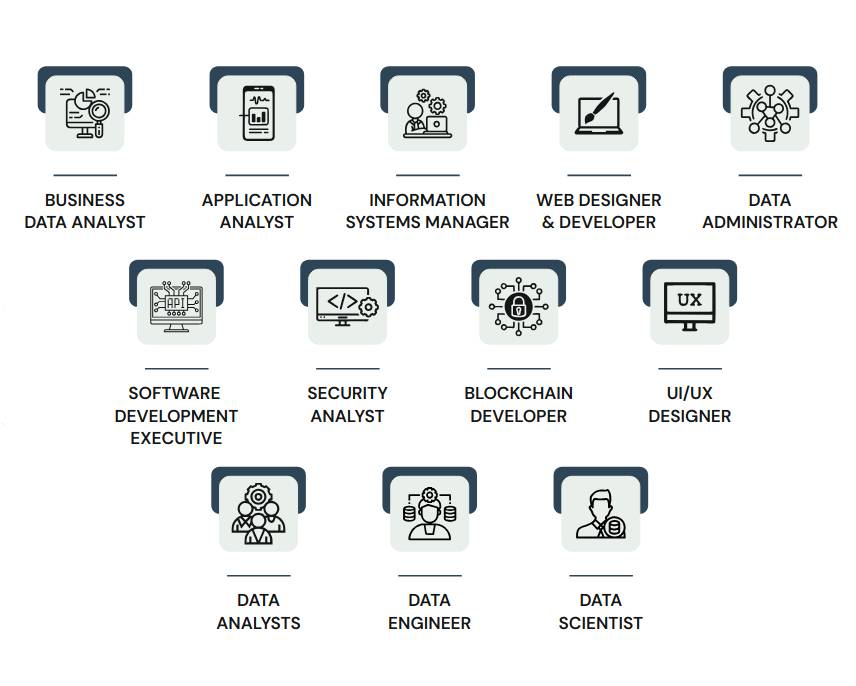
Career Prospects
Admission Process
- The admission to MCA is done in a centralized manner by the Admission Committee of Professional Courses (ACPC). Out of the total seats, 50% of seats are filled under management Quota by the institute as per ACPC norms.
- For further guidelines, please visit: https://gujacpc.admissions.nic.in/
Eligibility Criteria
- Mandatory Requirement: The aspiring candidate shall have appeared in CMAT examination conducted by NTA (prescribed by AICTE) and shall have passed qualifying examination with minimum 50% (45% for SC/ST/SEBC/EWS categories) for MCA course.
- A candidate shall have passed qualifying examination of B.C.A. / B.Sc. (Computer Science) / B.Sc. (IT) / B.E. (CSE) / B.Tech. (CSE) / B.E. (IT) / B.Tech. (IT) or equivalent Degree or passed any graduation degree (e.g. B.E. / B.Tech. / B.Sc. / B.Com. / B.A. / B.Voc. / etc.) preferably with Mathematics, Business Mathematics or statistics at 10+2 level or, as the case may be, at Graduation level with minimum 50% (45% for SC/ST/SEBC/EWS categories) in accordance with prevailing admission rules and AICTE guidelines.
- For students having no Mathematics background compulsory bridge course will be framed by the respective University/ Institution and additional bridge courses related to computer subjects as per the norms of the concerned University.
- For final eligibility status please visit https://gujacpc.admissions.nic.in/
Pedagogy
A variety of methods, including lectures, presentations, webinars, hands-on sessions, workshops,
MOOCs, interactive discussions, study tours, and industry projects, are utilized to strengthen students'
conceptual understanding, analytical skills, knowledge acquisition, and decision-making abilities,
preparing them to meet the challenges of the professional world. The pedagogy also incorporates case
studies, group collaborations, peer learning, flipped classrooms, and real-time simulations to promote
active engagement and critical thinking. Instruction takes place in well-maintained classrooms and
computer labs that are regularly sanitized to ensure a conducive learning environment.
Live Projects
Though classroom learning is given emphasis at FCAIT-PG, MCA Programme, students are required to undertake a number of practical projects in the different courses of the programme for which the information gathered from business/industry is analyzed and presented in the form of reports.
Capstone Project
Every student in the final semester of the programme is required to undertake a live full time project assignment in the industry. A student chooses a topic on which primary data is gathered and analyzed in order to prepare a working system, for which he/she is supposed to work in the industry for 6 months. At the end of the duration a project report for the same is prepared that is evaluated by a panel of experts.
Curriculum w.e.f. - June 2026
| Semester I | Semester II |
|
|
| Semester III | Semester IV |
|
|
Curriculum w.e.f. - June 2023
| Semester I | Semester II |
|
|
| Semester III | Semester IV |
|
|